
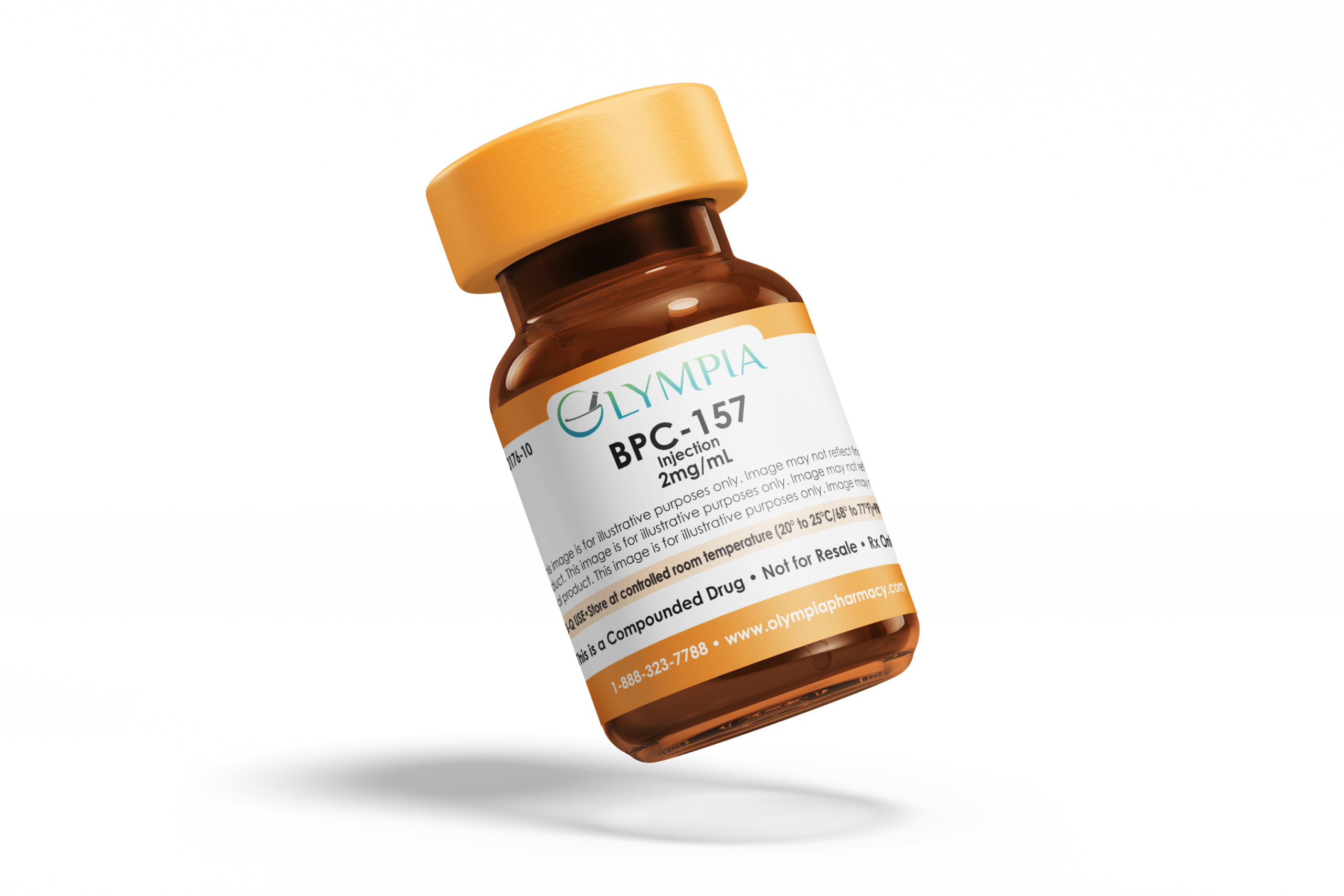
BPC-157 is a synthetic peptide that has drawn wide interest for its possible role in tissue repair. Olympia’s licensed 503A pharmacy plans to compound it for patients with a valid prescription, under an interim HHS policy issued in October 2026.
BPC-157 is not FDA-approved for any condition. The interim policy is temporary and subject to change.
What Is BPC-157?
BPC-157 (Body Protection Compound-157) is a synthetic peptide made of 15 amino acids. Its sequence is based on part of a protein found in human gastric juice.
Researchers have studied it mainly in animal and laboratory models of tendon, ligament, muscle and gut tissue. In those studies, it appears to act through nitric oxide pathways and the growth of new blood vessels. Well-controlled human studies are limited, so its effects in people are not well established.
What Does the Research on BPC-157 Show?
A 2025 systematic review in HSS Journal examined 36 studies of the peptide published between 1993 and 2024.[1] Thirty-five were preclinical (animal or laboratory) studies, and one was a small study in people. Its main findings:
- Animal studies: the peptide was linked to better healing outcomes in muscle, tendon, ligament and bone injury models.
- How it may work: the studies suggest it acts on pathways involved in cell growth and new blood vessel formation, and lowers some inflammatory signals.
- The one human study: a small retrospective review in which 7 of 12 patients with chronic knee pain reported relief lasting more than six months after a single injection into the knee.[1]
- Safety: animal studies did not show harmful effects, but the review found no clinical safety data in people.
In the body, it is broken down by the liver and cleared by the kidneys, with a half-life of less than 30 minutes.[1] Because nearly all of the evidence comes from animals, these findings cannot be assumed to apply to people. The review’s authors also noted that adverse effects are possible from unregulated manufacturing, contamination or unknown clinical safety.
Other Areas Researchers Are Studying
Beyond muscle, tendon and joint injuries, laboratory and animal studies have looked at BPC-157 in several other areas.[6,7]
- Gut lining: BPC-157 is based on a protein found in gastric juice, and much of the early research focused on the digestive tract. In rats, it has been studied in stomach damage caused by alcohol and NSAID pain relievers, in models of inflammatory bowel disease, and in fistulas, which are abnormal openings between organs.[6,7]
- Skin and wound healing: in rat and mouse models of cuts, burns and diabetic wounds, BPC-157 was linked to faster wound closure, better-organized collagen and the growth of new blood vessels.[6,7]
- Inflammation: animal studies reported lower levels of some inflammatory markers, such as IL-6 and TNF-alpha, and less swelling and fewer inflammatory cells in burn models.[6,7]
These findings come almost entirely from rats and mice, and much of the research comes from the same group of scientists who first described the peptide. BPC-157 was tested in early human studies, including for ulcerative colitis, but detailed results have not been published.[6]
Is BPC-157 FDA-Approved?
No. BPC-157 is not FDA-approved to diagnose, treat or prevent any condition. In July 2026, the FDA’s Pharmacy Compounding Advisory Committee voted in favor of adding it to the list of substances that 503A pharmacies may compound.[2] On October 28, 2026, HHS issued an interim policy that allows state-licensed 503A pharmacies to compound it under specific conditions while the FDA completes its review.[3]
For the full timeline and what the policy requires, read Peptides in 2026: Where the FDA Review Stands.
Why BPC-157 Quality and Sourcing Matter
Much of the BPC-157 sold online is labeled “for research use only,” which means it is not made or tested for use in people. The HHS interim policy requires compounding pharmacies to source it from FDA-registered manufacturers with a valid certificate of analysis, so patients have an alternative to unregulated research products.[3]
Why Is BPC-157 Banned in Sports?
The World Anti-Doping Agency (WADA) lists BPC-157 as a prohibited substance under its S0 category for non-approved substances, which covers drugs not approved for human use by any government health authority.[4] Athletes who are subject to drug testing should check their organization’s rules before using any peptide. See the WADA Prohibited List.
How Is BPC-157 Given?
In research and clinical use, the peptide has most often been given by injection. Under the interim policy, compounded preparations may only be paired with an FDA-cleared syringe as its delivery device, and an oral form requires documented evidence that the body absorbs it adequately.[3] Your provider will decide the form and dose that fit your care plan.
How Olympia Will Compound BPC-157
Olympia announced on November 12, 2026 that its 503A pharmacy will compound BPC-157.[5] Every preparation will meet the policy’s conditions and our own pharmacy standards:
- Ingredients sourced from FDA-registered manufacturers
- Identity and purity verified on every ingredient lot
- Sterility and endotoxin testing on every sterile preparation
- Single-ingredient preparations, never blended
- Dispensed only with a valid, patient-specific prescription, after pharmacist review
Frequently Asked Questions
This content is for educational purposes only and is not a substitute for advice from a licensed medical provider. BPC-157 is not FDA-approved. Compounded preparations are prepared by Olympia Pharmaceuticals with oversight by state pharmacy boards. Always consult a medical professional before beginning any new regimen.
References
- Vasireddi N, Hahamyan H, Salata MJ, et al. Emerging Use of BPC-157 in Orthopaedic Sports Medicine: A Systematic Review. HSS Journal, 2025.
- U.S. Food and Drug Administration. July 23–24, 2026: Meeting of the Pharmacy Compounding Advisory Committee.
- U.S. Department of Health and Human Services. Enforcement Discretion Policy Regarding 503A Compounding Using Certain Peptide Bulk Drug Substances. Federal Register, October 30, 2026.
- World Anti-Doping Agency. Prohibited List.
- Olympia Pharmaceuticals. Olympia Pharmaceuticals to Compound Select Peptides Under HHS Interim Enforcement Policy. GlobeNewswire, November 12, 2026.
- Seiwerth S, Milavic M, Vukojevic J, et al. Stable Gastric Pentadecapeptide BPC 157 and Wound Healing. Frontiers in Pharmacology, 2021.
- Józwiak M, Bauer M, Kamysz W, Kleczkowska P. Multifunctionality and Possible Medical Application of the BPC 157 Peptide: Literature and Patent Review. Pharmaceuticals, 2025.